Operations Consultant vs. Fractional COO vs. Business Coach
You've decided you need outside help.
Then you start looking, and the titles blur. Operations consultant. Fractional COO. Business coach. All three promise a business that works better without you carrying every part of it.
They solve three different problems. Picking the wrong one costs you months and a contract you can't use.
What does an operations consultant do?
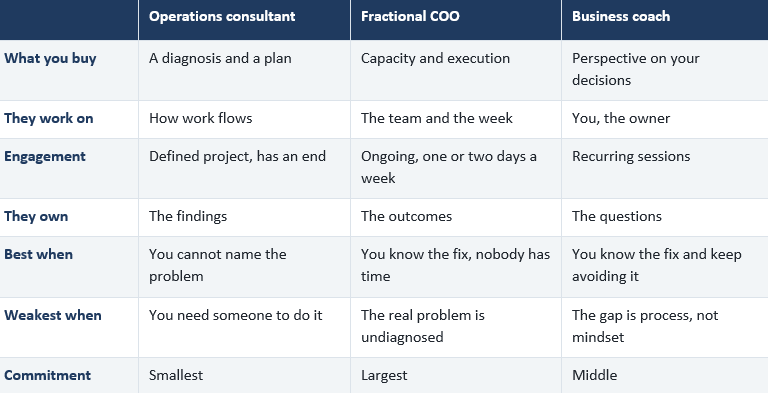
An operations consultant diagnoses how work actually moves through your business, then tells you what to fix and in what order. They come in for a defined period, examine your workflows, handoffs, and decision points, and hand you a plan.
What you're buying is the diagnosis. A good one will tell you the problem you have isn't the problem you described when you called.
They don't run your company or sit in your Monday meeting for a year. The engagement ends, and you own the plan.
What is a fractional COO?
A fractional COO (Chief Operating Officer) is a part-time operations executive who holds a seat in your business, usually one or two days a week. They run the team, the meeting rhythm, and the numbers.
What you're buying is capacity. You're hiring someone to carry the operational weight you're carrying now.
That works when you already know what needs to happen and you need a person to make it happen every week. It is the largest commitment of the three, in cost and in time.
What does a business coach do?
A business coach works on you. Your decisions, your priorities, the conversations you keep postponing, the way you spend a Tuesday.
What you're buying is perspective. A coach asks questions until you reach your own answer, which is genuinely valuable when the constraint is how you are leading.
It's the wrong tool when the constraint is that nobody has written down how a job gets quoted. A coach will not rebuild your intake process, and you shouldn't ask them to.
At a glance
Which one do you need?
Match the role to the problem, not to the pain. The pain feels the same in all three cases.
If you can't name the problem, you need a diagnosis.
If you can name it and nobody has the time to fix it, you need capacity. That's the fractional COO.
If you can name it, you have the time, and you're still not doing it, the constraint is you. That is the coach.
Most owners are in the first group and hire from the second or third. That’s how you end up paying a monthly retainer for someone to run a system nobody has examined yet.
This is why we start with a diagnosis. The Business Momentum Reset includes a 90-minute assessment session, a customized Momentum Blueprint with a prioritized 30-day roadmap within 48 hours, and a 14-day scoped sprint to implement a single fix.
Sometimes the answer is a fractional COO. Sometimes it is a coach. Sometimes it is one broken handoff you can fix yourself in a month. Either way, before you sign the next contract, you’ll know exactly what it's for.
Key takeaway: All three roles are legitimate. Only one of them matches the problem that you actually have, and you can't choose one until you can name that problem.
Common questions
Do I need a fractional COO or an operations consultant?
It depends on whether you can name your problem. An operations consultant diagnoses what's slowing your business and gives you a plan to follow. A fractional COO executes a plan you already have, week after week, as a part-time member of your leadership team.
If you're still guessing the cause, start with the diagnosis. Paying an executive retainer to run a system nobody has examined is an expensive way to discover you had a different problem.
What's the difference between a business coach and a consultant?
A coach works on you. A consultant works on your business. A coach asks questions to help you reach your own decisions and is most valuable when the constraint is your leadership, your priorities, or your confidence.
A consultant examines how the work itself flows and tells you what to change. If the answer lives in your head, hire a coach. If the answer lives in your operations, hire a consultant.
How do the costs compare?
The structures differ more than the rates do. An operations consultant charges a fixed project fee with a defined end date. A fractional COO is an ongoing monthly retainer and the largest of the three commitments. A coach is usually billed per session or as a monthly package. The real cost is choosing wrong, because a year of the wrong engagement costs far more than a diagnosis does.
The Business Momentum Reset delivers a prioritized 30-day roadmap within 48 hours, including a 14-day scoped Momentum Sprint.